
1. Fundamental Operating Principles
1.1 Traction Elevators
Traction elevators use steel wire ropes or belts to suspend the car and counterweight from a traction sheave driven by an electric motor. The fundamental principle is friction: the ropes grip the grooved surface of the traction sheave, and as the sheave rotates, the ropes move, raising or lowering the car. The counterweight, typically equal to the car weight plus 40-50% of rated capacity, balances the system and minimizes the motor torque required for operation.
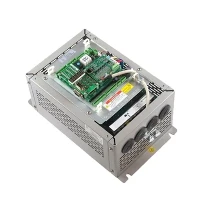
Modern traction elevators employ variable voltage variable frequency (VVVF) drives to control motor speed and torque. The drive rectifies AC mains power to DC, then inverts it back to variable-frequency AC, allowing precise speed control from zero to rated speed with high efficiency. Regenerative drives can return energy to the building grid during descent or deceleration, further improving efficiency.
1.2 Hydraulic Elevators
Hydraulic elevators operate on Pascal's principle: an electrically driven hydraulic pump forces oil into a cylinder, pushing a piston that raises the car. For descent, a control valve releases oil from the cylinder back to the reservoir, and the car descends under gravity. Unlike traction systems, hydraulic elevators do not use ropes - the piston directly supports the car load.
There are two primary configurations. In-hole (direct-acting) systems place the cylinder in a borehole below the elevator pit, with the piston extending upward to support the car. Hole-less systems use side-mounted telescoping pistons that extend alongside the car, eliminating the need for deep drilling. Hole-less designs are particularly advantageous in areas with high water tables or bedrock near the surface.
2. Performance Comparison
| Parameter | Traction Elevator | Hydraulic Elevator |
|---|---|---|
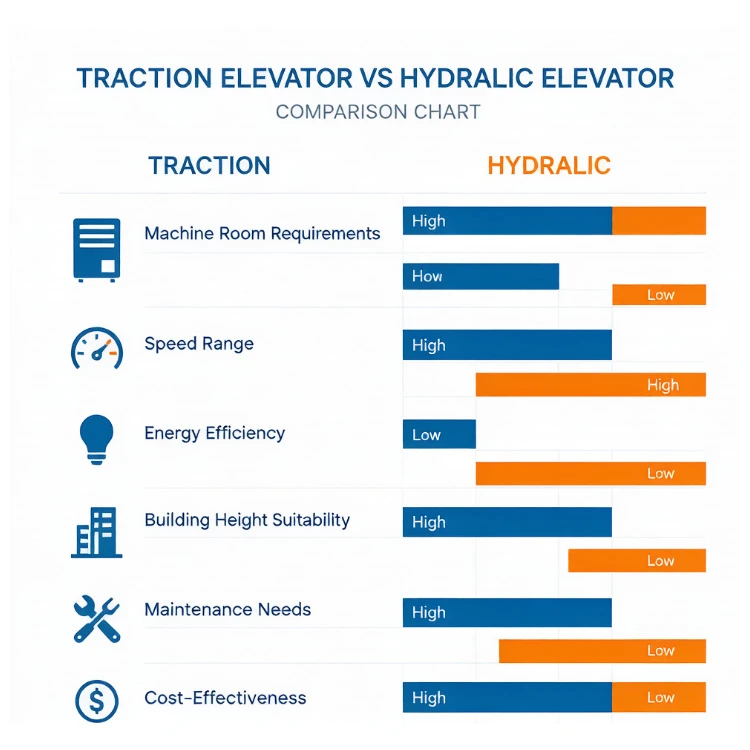
| Speed Range | 0.5 – 10+ m/s | 0.15 – 1.0 m/s |
| Travel Height | Unlimited (practical: 600+ m) | Typically ≤ 21 m (6-7 floors) |
| Load Capacity | 320 – 5,000+ kg | Up to 20,000+ kg (freight specialty) |
| Energy Efficiency | High (regenerative available) | Moderate (no counterweight) |
| Ride Smoothness | Excellent | Good (oil temperature affects performance) |
| Machine Room | Required (or MRL option) | Required for pump unit |
| Installation Time | 2 – 4 weeks | 1 – 2 weeks |
| Initial Cost (typical) | Higher | Lower for low-rise |
| Maintenance Cost | Lower long-term | Higher (oil system maintenance) |
| Noise Level | Very low (machine room isolated) | Higher (pump room noise) |
3. Energy Efficiency Analysis
Energy consumption is where the two technologies diverge most significantly. Traction elevators with counterweights are inherently efficient because the motor only needs to overcome the imbalance between car and counterweight loads, plus friction and acceleration forces. A modern VVVF traction elevator can achieve energy consumption of 0.3-0.6 kWh per 1,000 kg-m of transport work.
Hydraulic elevators lack a counterweight, meaning the motor-pump unit must supply the full hydraulic pressure to raise the car regardless of load. During descent, energy is dissipated through the control valve as heat rather than recovered. Typical hydraulic elevator consumption ranges from 1.0-2.5 kWh per 1,000 kg-m - roughly 3-4 times higher than traction equivalents.
Regenerative drive advantage: Modern regenerative traction drives can recover 20-40% of the energy used during descent, feeding it back into the building's electrical grid. Over a 20-year service life in a high-traffic building, this recovery can offset a significant portion of the initial cost premium.
For buildings seeking LEED certification or operating in jurisdictions with strict energy codes, traction elevators are increasingly the only viable option. However, for low-rise buildings with minimal daily usage, the efficiency gap may be too small to justify the higher initial investment.
4. Installation and Space Requirements
4.1 Shaft and Pit Requirements
Traction elevators require a substantial overhead structure to support the machine room (or the overhead traction machine in MRL designs). The minimum overhead dimension (distance from top landing floor to shaft ceiling) ranges from 3.8 meters for standard machine-room elevators to 3.2 meters for MRL configurations. Pit depth is typically 1.2-1.8 meters depending on speed and buffers.
Hydraulic elevators have more flexible overhead requirements - often as little as 3.0 meters - because the machine room is adjacent to the shaft rather than above it. However, in-hole hydraulic systems require drilling a deep borehole below the pit, which can encounter obstacles such as bedrock, groundwater, or underground utilities. The drilling cost can add $5,000-$20,000 to the project, depending on ground conditions.
4.2 Machine Room Considerations
Traction machine rooms must be positioned directly above the shaft or offset within a specified maximum distance (typically 15-20 meters horizontally per EN 81-20). The room must support the static and dynamic loads of the traction machine, which can exceed 5,000 kg for high-capacity installations. Vibration isolation between machine room and building structure is critical to prevent noise transmission.
Hydraulic machine rooms (pump rooms) can be located up to 15 meters from the shaft and require only floor-level support. However, they must accommodate the hydraulic power unit, oil reservoir, and control cabinet, with minimum room dimensions of approximately 2.5 m × 2.0 m × 2.2 m height. Noise and oil temperature management require ventilation, and oil containment measures (spill trays) are mandatory in many jurisdictions.
5. Total Cost of Ownership
The total cost of ownership (TCO) over a 25-year service life typically favors traction elevators for mid-rise and high-rise applications, while hydraulic systems may offer lower TCO in specific low-rise scenarios.
| Cost Component (25-year, 6-stop building) | Traction | Hydraulic |
|---|---|---|
| Initial Equipment & Installation | $75,000 – $120,000 | $45,000 – $75,000 |
| Energy (cumulative) | $18,000 – $28,000 | $55,000 – $85,000 |
| Maintenance & Service Contracts | $45,000 – $65,000 | $55,000 – $80,000 |
| Major Overhauls (1-2 per lifecycle) | $12,000 – $20,000 | $15,000 – $25,000 |
| 25-Year TCO (typical range) | $150,000 – $233,000 | $170,000 – $265,000 |
Notes: Costs are indicative for a 630 kg, 6-stop passenger elevator in a medium-traffic commercial building. Actual costs vary significantly by region, traffic patterns, and service contract terms.
6. Application Guidelines
Based on the technical characteristics, the following selection guidelines apply:
Choose Traction for: Buildings with more than 5-6 floors; high-speed requirements (>1.0 m/s); heavy traffic (>300 trips/day); energy-sensitive projects; applications requiring regenerative drives; high-rise residential or commercial towers.
Choose Hydraulic for: Low-rise buildings (2-4 floors); heavy freight applications (especially asymmetric loads); retrofits where shaft headroom is severely limited; temporary or modular installations; budget-constrained projects with low traffic.
7. Emerging Technology: Machine-Room-Less (MRL) Traction
Machine-room-less (MRL) traction elevators represent a convergence of technologies, offering the efficiency and speed of traction systems without the space penalty of a traditional machine room. The traction machine is mounted within the shaft, either on the car guide rails or in the overhead space. MRL elevators now account for over 60% of new traction installations in Europe and are gaining market share globally.
MRL designs require careful thermal management of the compact motor and drive, and maintenance access to the machine is more complex than in traditional designs. However, for building developers, the elimination of the machine room can recover 10-15 m² of usable floor area per elevator - valuable real estate in urban developments.