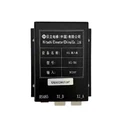

3. Door Operator Board Problem
The door operator board uses a three-phase control system with voltage and speed regulation. After the door closes, one phase maintains a small torque through a resistor to reduce voltage and prevent the door from opening again. This is why the Mitsubishi SPVF elevator always outputs a closing signal during operation. However, this also places high demands on the door operator board's electronic components due to its long-term operation. The door position signal is sampled through an optical encoder. The position of the encoder is crucial. Although it appears fixed, it can be fine-tuned. Essentially, during the opening and closing process, you must see the LED light cycle through on-off-on-off-on. Otherwise, the elevator door may appear normal, but the terminal motor is still running, eventually leading to door operator board failure. Unless the door operator board is completely waterlogged and unusable, it's relatively easy to repair. See those red modules? That's usually where the problem lies; replacing them will solve the issue.
4. Self-protection upon startup
Most elevators have a fault detection system. The self-protection upon startup indicates that the fault is only detected during operation, such as elevator overcurrent, encoder no output, or mismatched drive data. Because older elevators could not memorize faults, this self-protection fault recurred after each power outage. To address this, we first need to find the cause of the self-protection. Without a repair machine, we first check the encoder. The encoder output should be 2.5V AC when the motor is rotating, and less than 1VDC when it stops. If the encoder is fine and the external wiring is normal, the problem might be caused by overcurrent. This could be a genuine overcurrent in the output, such as motor overcurrent or elevator overload, or a problem with the current detection unit (DC-CT). We can detect the bias voltage of the CT on the E1 board. If it's abnormal, the OFS potentiometer of the DC-CT needs adjustment. How to adjust it is described in the SPVF installation and commissioning manual.